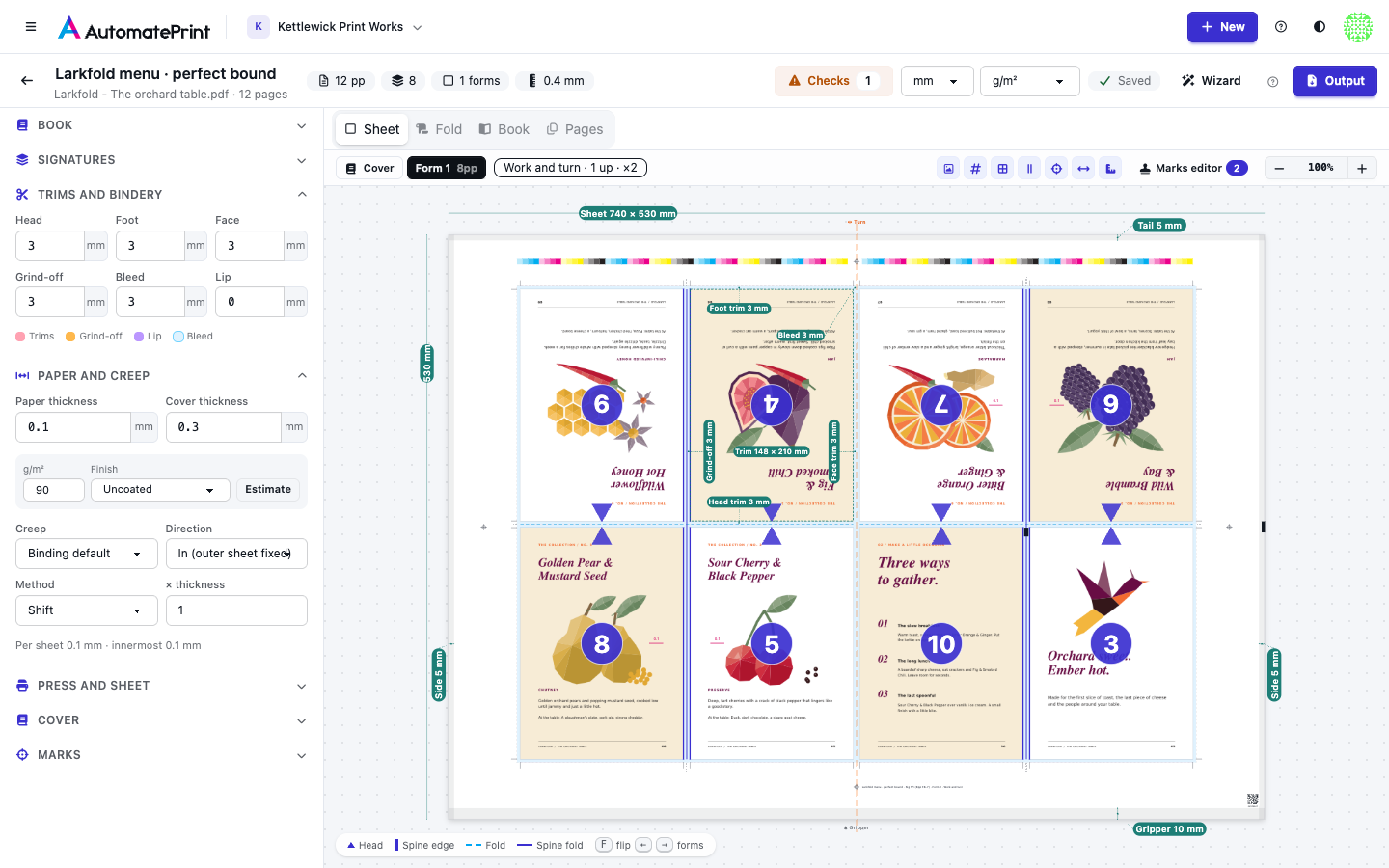
The bindery trims, mills and folds the printed sheets, and each step needs room on the sheet. Booklets gives every page edge its allowance and shows them on the Sheet view when Bindery zones is on: trims in rose, grind-off in amber, the lip in violet, each labelled with its size.
Binding styles#
The binding sets how signatures go together and the default spine and lip allowances. Every default can be changed.
| Binding | Assembly | Grind-off | Lip | Creep | What it is |
|---|---|---|---|---|---|
| Saddle stitch | Nest (inset signatures) | 0 mm | 8 mm (0 on digital) | On | Folded sheets nested inside each other and stapled through the spine fold. |
| Perfect bound | Gather (stack signatures) | 3 mm | 0 | On | Signatures gathered, the spine milled off and glued into a cover. |
| PUR / lay-flat | Gather (stack signatures) | 2.5 mm | 0 | On | Like perfect binding, with polyurethane glue: thinner grind-off, opens flatter. |
| Section sewn (Smyth) | Gather (stack signatures) | 0 mm | 0 | On | Signatures gathered and sewn through their spine folds (Smyth sewing). |
| Case bound (hardcover) | Gather (stack signatures) | 0 mm | 0 | On | Sewn signatures in a hardcover case. |
| Side stitch | Gather (stack signatures) | 0 mm | 0 | Off | Gathered sheets stapled through the side, near the spine. |
| Wire-O / spiral | Gather (stack signatures) | 0 mm | 0 | Off | Single leaves punched and bound with wire or plastic coil. |
Head, foot and face trims#
Head, Foot and Face are what the three-knife trimmer cuts off each page beyond its trim: 3 mm each by default (about ⅛ in). Two pages that meet head to head get two head trims between them. Signatures of 16 pages or more have a closed head (a fold at the head that must be cut open): a head trim of 5 mm is safer, and the checks say so.
Bleed is how far artwork may run past the trim, 3 mm by default. It never crosses into a neighbouring page: at a saddle-stitch spine fold, where there is no allowance, artwork stops at the fold.
Grind-off#
Grind-off is milled off the spine before gluing: 3 mm a page for perfect binding and 2.5 mm for PUR by default, so the two pages either side of a spine fold sit 6 mm apart. Sewn, case-bound and stitched books have none. Artwork may bleed into it.
The lip#
A lip makes one half of a signature longer so the stitcher can open it at the middle: 8 mm by default for saddle stitching on offset, none on digital presses (inline booklet makers don't need it).
- Lip on the: Low folio puts it on the leaves with the first half of the signature's pages, High folio on the second half. Ask your bindery which their stitcher needs.
- Lip edge: on the face (usual) or the foot.
Paper thickness#
Paper thickness drives creep, the spine and how big a signature can be. If you only know the paper's weight, the estimate in Paper and creep multiplies it by a typical bulk (about 1.25 for uncoated, 0.95 for silk or matt, 0.85 for gloss): measure a sheet with a micrometer to be sure. Heavier paper folds into smaller signatures: up to 32 pages under 90 g/m², 16 up to 150 g/m², then 8, and 4 above 250 g/m².
Creep#
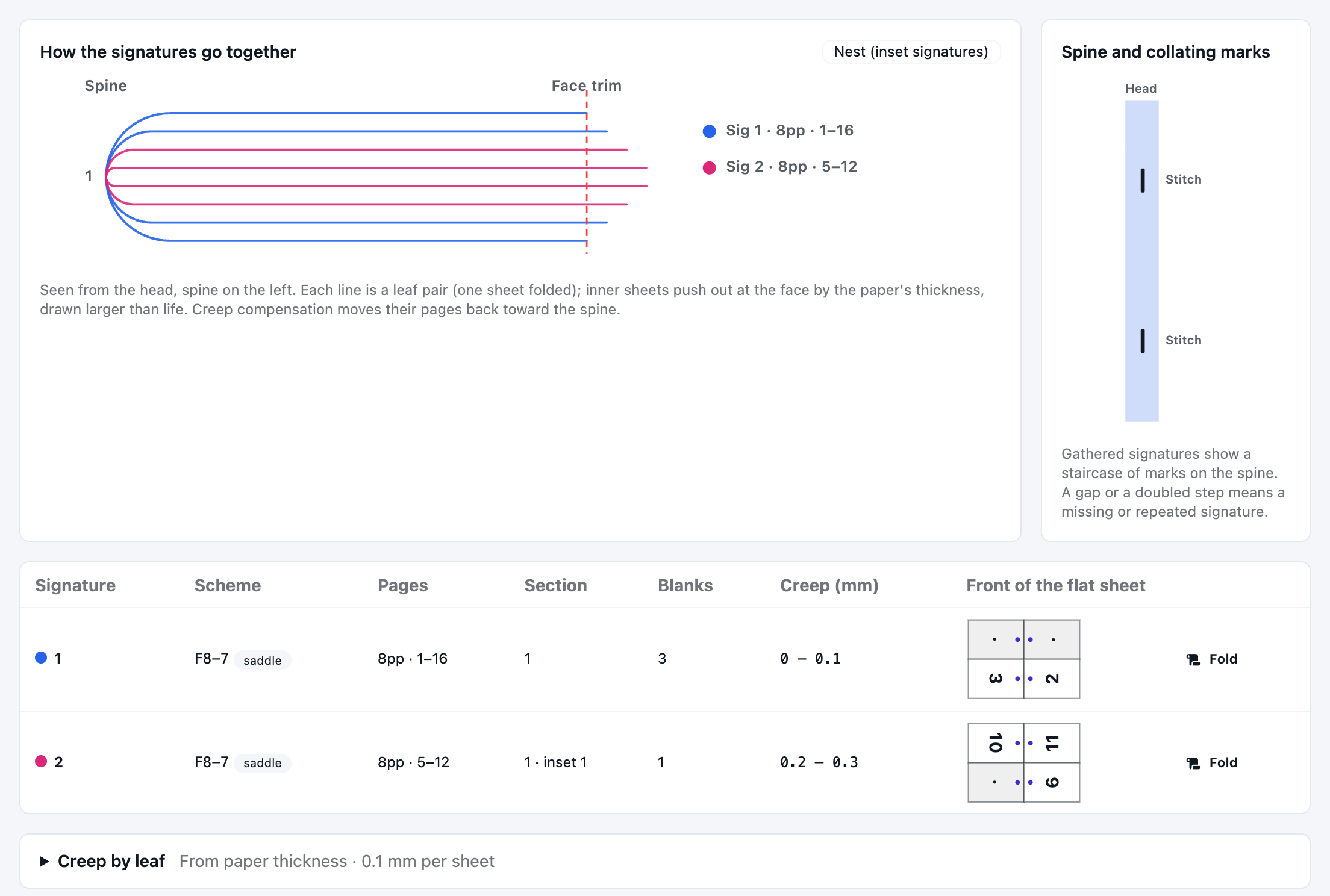
Creep is how much further out the inner sheets of a nest reach at the face: each sheet wraps around the ones inside it. After trimming, their pages would be narrower and their face margins smaller, so their artwork is moved toward the spine instead. Creep is worked out per sheet of nesting, also inside a signature folded more than once.
- Creep: From paper thickness (per sheet: the thickness × × thickness, 1 by default; shops often find 1.1 to 1.2 matches their dummies), Manual (Per sheet in mm) or Off. Saddle stitching and perfect, PUR and sewn bindings have it on by default.
- Direction: In keeps the outermost sheet still and moves the inner ones toward the spine (the usual); Out keeps the innermost still and moves the outer ones away from it; Both keeps the middle sheet still.
- Method: Shift moves the artwork; Scale shrinks it toward the spine instead, for tight margins (with Out, the outer sheets' artwork grows away from the spine).
A separate cover adds its own thickness outside a nested body. Hover a page on the Sheet view for its creep, or open the Book view for each signature's range and Creep by leaf for every leaf. The checks warn when creep moves artwork further than the bleed.